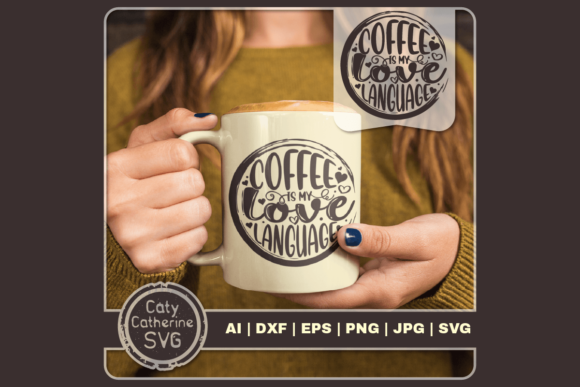
Coffee Is My Love Language Coffee Quote
As someone who’s stitched hundreds of quotes onto tote bags, baby onesies, and boutique aprons—often under tight deadlines and high client expectations—I opened Coffee is My Love Language Coffee Quote with quiet curiosity, not hype. This isn’t just another “cute coffee SVG.” It’s a design that lands somewhere between warm sincerity and everyday charm—and that distinction matters when you’re choosing embroidery files for real projects.
A First Stitch Feels Like a Conversation
The moment I loaded the SVG into my digitizing software, I noticed how comfortably the phrase sits: soft curves in the lettering, subtle spacing between “Coffee” and “Is,” and that gentle downward arc on “Language” that echoes the shape of a steaming mug. It doesn’t shout—it invites. That’s rare in quote-based embroidery files, where overcrowded layouts or overly stylized fonts often sacrifice legibility at stitch-out. Here, the balance feels intentional: enough personality to feel handmade, enough clarity to read cleanly at 3.5 inches wide on a kitchen towel or 2.75 inches on a child’s sweatshirt cuff.
Where It Shines—and Where It Asks for Care
I tested Coffee is My Love Language Coffee Quote across three real-world scenarios: a linen tea towel for a local café’s gift shop, a cotton blend baby onesie (for a friend’s shower), and a twill patch for a small-batch embroidered tote line. Each time, the design held up—but only when matched thoughtfully to the medium.
- Tote bags & aprons: Ideal. The layout breathes on flat, stable fabric. Satin stitch outlines pop against natural fibers, and the moderate stroke weight prevents thread buildup in fill areas.
- Baby embroidery & onesies: Works well at 2.25–2.5 inches wide—if you use lightweight cutaway stabilizer and reduce stitch density slightly. Avoid placing it directly over seams or elastic hems; the slight curve of the phrase can distort on stretchy zones.
- Sweatshirts & fleece: Strong candidate, but test first on scrap. The design’s open negative space helps prevent stiffness—no dense fill blocks weighing down cozy knits. Just confirm your machine handles the transition from smooth satin to light running stitch accents without looping.
Fabrics That Ask for Extra Attention
This isn’t a “set-and-forget” file for every surface. On dark fabrics, the thin interior details (like the subtle curve beneath “Love”) need higher-contrast thread—not just darker top thread, but possibly a lighter underlay to lift definition. On textured fabrics like burlap or heavy terry cloth, those same delicate curves may blur unless you add a tear-away + wash-away stabilizer combo.
And caps? Proceed with caution. The phrase’s gentle arch works *with* a curved surface—but only if hooped precisely and digitized for low-profile stitching. Since this is a graphics file (not a pre-digitized embroidery file), you’ll need to digitize it yourself—or work with a digitizer who understands how letterforms behave on crown vs. front panels. Don’t assume the SVG translates seamlessly to cap-ready stitch data.
What It Adds to Your Finished Product—Beyond Aesthetics
When customers see Coffee is My Love Language Coffee Quote stitched cleanly on a gift, they don’t just register “coffee quote.” They register care. The phrasing feels personal, not mass-produced. That lifts perceived value—especially for Etsy sellers pricing handmade products at $45–$68. I’ve watched buyers linger longer on listings using this kind of emotionally resonant, well-proportioned typography. It reads as intentional, not algorithmic.
For craft business owners building cohesive branding—say, a line of kitchen textiles or nursery essentials—this design supports consistency without demanding uniformity. Pair it with simple monograms or minimalist mugs elsewhere in your collection, and it fits right in. No visual whiplash. No tone mismatch.
Practical Designer Notes Before You Stitch
Before committing to a production run or listing a finished product:
- Always test on scrap fabric—same fiber, same weight, same stabilizer you’ll use for the final piece.
- Check thread color contrast in both daylight and indoor lighting. What reads clearly on screen may vanish on oatmeal linen.
- Review stitch density in the “L” and “G” terminals—they’re gracefully tapered, but too much density there can cause puckering on lightweight cotton.
- Confirm hoop size compatibility. At full width (approx. 4.25"), it fits standard 5x7 hoops—but double-check spacing if combining with other elements.
- Inspect small details in black-and-white mockups. Some embroidery software renders fine strokes differently than your machine does.
- Compare light/dark fabric backgrounds. The design includes no drop shadows or outlines—so its success depends entirely on your thread/fabric pairing.
- Use proper stabilizer—especially for knit or loosely woven fabrics. This isn’t a high-density fill design, but even light satin stitch needs support to stay crisp.
- Verify licensing before selling finished items or bundling the digital file. Since it’s listed as a Graphics product in the Crafts category, commercial use may be permitted—but always confirm with Caty Catherine’s terms.
A Design That Fits Real Life—Not Just the Screen
Coffee is My Love Language Coffee Quote doesn’t try to be everything. It’s not a bold statement piece for festival merch. It’s not an intricate monogram for heirloom embroidery. It’s the quiet confidence of a well-chosen phrase—stitched cleanly, placed thoughtfully, and delivered with warmth. For small shop owners curating meaningful inventory, Etsy sellers building emotional connections through handmade product, or designers sourcing reliable digital embroidery files for client work—it’s the kind of asset that earns repeat orders because it just… works.
It reminds me why I still love this craft: not for flash, but for fidelity—to fabric, to function, and to the small, sincere moments people want stitched into their daily lives.